WARNING:This product contains nicotine.Nicotine is an addictive chemical.

Why 30,000–50,000-Puff Vapes Are Becoming the New Trend: 5 Real User Pain Points
Walk into any vape shop in 2025 and you’ll hear the same complaints over and over:
“I’m sick of burning through three little disposables every week.”
“Traveling with five backup bars in my bag is ridiculous.”
The rise of 30,000–50,000-puff “high-puff” disposables is not just brands showing off. It’s a direct response to these real-world frustrations from heavy and medium-heavy vapers.
If you’re not yet familiar with what counts as “high-puff” (10K, 20K, 30K, 50K, etc.), it’s worth reading our guide What Is a High-Puff Disposable Vape? First, then coming back here. That article explains the full puff spectrum; this one explains why the 30K–50K zone in particular has taken off.
If you want to see how these pain points connect with high-puff definitions, endurance testing and our 50K rankings, check our High-Puff Disposable Vapes 2025–2026 Guide for the full picture.
When you put user behavior, cost, and hardware design together, five core pain points explain the trend.
Pain Point 1: Constantly Swapping Devices Is a Hassle
Many vapers underestimate just how fast they go through smaller disposables until they start tracking their usage.
How Long Does a 2,000-Puff Device Really Last?
For a lot of daily vapers, 600–800 puffs a day is normal:
- A few sessions before work
- Several breaks during the day
- Evenings at home or out
On that kind of schedule:
- A 2,000-puff device lasts roughly 2–3 days
- A 600–800-puff stick may barely cover one long day
As one long-time user told us:
“When I was on 2K bars, I always had one in use, one half-dead in my pocket, and a fresh one in the drawer. Something was always running out.”
The Hidden Time, Money, and Mental Cost
Swapping small devices all the time creates three layers of friction:
- Time cost – repeated trips to the shop, or more frequent online orders
- Money cost – you’re paying full packaging and logistics on every tiny device
- Mental load – low-battery anxiety, constantly checking whether you have a backup
30K–50K disposables blunt all three. Instead of managing a rotation of half-dead sticks, a heavy user can treat one device as their “main setup” for weeks at a time.
Pain Point 2: Travelers Need Real Endurance, Not Marketing Numbers
Short trips expose the weakness of small-puff devices very quickly.
How Many Puffs Does a Trip Really Take?
Take a heavy vaper at 800 puffs/day:
- 3-day trip → about 2,400 puffs
- 7-day trip → about 5,600 puffs
- 14-day trip → about 11,200 puffs
Now map that to device sizes:
- On 2,000-puff bars, that same user needs:
- 2 bars for 3 days
- 3–4 bars for 7 days
- 6 bars or more for 14 days
- On a single 30K or 50K device, they realistically need one main device and maybe one small backup “just in case.”
As one frequent traveler put it:
“I used to pack a handful of 2K sticks and still worry I’d run out. With a 50K, I pack one bar and forget about it.”
Small-Puff vs 50K: How Many Bars in the Bag?
Small-Puff vs 50K: How Many Bars in the Bag?
For vapers who fly often or cross borders where vape choice is limited, the math is simple:
- Multiple small bars = more space, more customs questions, more chances to misplace or break one
- One 30K–50K device = less clutter, fewer worries, and less planning
That’s a big part of why high-puff devices show up so often in heavy travelers’ recommendations and in our own best 50,000-puff disposable vapes 2025 ranking.
If you’re planning a trip and want a broader packing strategy — how many devices to bring, which form factors travel best, and what to watch for with airport security and local rules — check our best disposable vapes for traveling 2025 guide for detailed, travel-specific advice.
Pain Point 3: Users Want Flavor and Power That Don’t Collapse Halfway
Even when puff counts look good on paper, many users complain that small devices “go soft” halfway through the tank.
What Happens as the Oil and Battery Run Low
On a typical small disposable:
- As the e-liquid level drops, wicking becomes less consistent
- As the battery voltage sags, power to the coil falls
- The result is a vape that feels:
- Weaker
- Less flavorful
- Sometimes harsh or inconsistent
You’ll hear comments like:
“The first half is great, the second half is just a weak, sad version of the same flavor.”
How High-Puff Devices Improve Consistency
Well-designed 30K–50K devices attack this in several ways:
- Larger, denser wicks that stay saturated even when the tank is low
- Regulated power so the coil sees a stable wattage until near the end
- Bigger batteries that don’t sag as quickly, even across long use
Instead of a sharp drop-off at the halfway point, the experience is more gradual and controlled. In our high-puff guide and 50K ranking, testers consistently report that good 30K–50K devices keep the “new-device feel” much longer than small sticks, even if the very last few percent of the tank still show the usual decline.
Pain Point 4: Users Think in “Cost per Day,” Not Just Price per Bar
Vapers rarely sit down with a calculator—but mentally, they do care about what a habit costs per week or per month.
Cost per 1,000 Puffs vs Cost per Bar
Imagine two simple scenarios:
- A 2,000-puff bar priced at $12
- A 50,000-puff device priced at $40
Cost per 1,000 puffs:
- 2,000-puff bar → about $6 per 1,000 puffs
- 50,000-puff device → about $0.80 per 1,000 puffs
Even if you adjust the numbers for your local prices, the pattern is the same: larger devices usually offer dramatically lower cost per puff.
From a user’s point of view:
“Yeah, the 50K costs more upfront. But when I look at how long it lasts, the smaller bars feel like a bad deal.”
Spreading Cost Over Time
When you look at cost per day instead of cost per bar, high-puff devices often win:
- Fewer purchases → fewer impulse add-ons at the counter
- Less delivery and shipping overhead
- More predictable monthly spend
That’s why you’ll increasingly see heavy vapers and budget-conscious users recommending “one good 30K–50K” over constant buying of cheaper, smaller sticks.
Pain Point 5: Environmental Guilt and Device Waste
Many users are uncomfortable with the idea of throwing away hardware every few days.
The Waste Problem with Small Devices
A single 2,000-puff bar might not feel like much, but over time:
- 1 heavy vaper using a 2K stick every 3 days discards about 10 devices per month
- Over a year, that’s 120 batteries, shells, coils, and chipsets
It’s no surprise you hear lines like:
“I know these are small, but it still feels wrong throwing so many away.”
How Many Small Bars Does One 50K Replace?
Purely in puff count:
- One 50,000-puff device can replace roughly 25 separate 2,000-puff devices
That doesn’t make a 50K disposable “green,” but from a user perspective:
- Fewer shells, fewer batteries, fewer boxes
- Less visible weekly trash
- A small but real reduction in per-puff hardware waste
For vapers who care about both convenience and footprint, “I’d rather throw away one device than twenty” becomes a powerful argument for high-puff options.
Why the Trend Stabilizes Around 30K–50K Instead of 100K
If bigger solves so many pain points, why haven’t 80K or 100K disposables taken over? In practice, 30K–50K is where user needs and engineering limits meet.
Size and Weight Reach a Practical Limit
Every extra mL of e-liquid and every extra mAh of battery adds:
- Bulk in the pocket
- Weight in the hand
- More demanding thermal and safety requirements
Above a certain point, the device stops feeling like a convenient disposable and starts feeling like a small box mod. For many users, 30K–50K is the highest puff range that still feels “grab-and-go”.
Flavor Fatigue and Safety Boundaries
Even if you could build a 100K device that’s comfortable:
- Very few people want the exact same flavor for that many puffs
- Total nicotine content would raise more regulatory concerns
- The risk of misuse, loss, or damage over such a long life goes up
Brands can address flavor fatigue with dual-flavor designs or modular systems, but beyond 50K the practical and regulatory downsides start catching up.
30K–50K: The Current “Sweet Spot.”
Right now, 30K–50K is the “sweet spot” where:
- Heavy users get weeks of runtime
- Devices stay pocketable and simple
- Cost per puff starts to look very attractive
- Flavor options and hardware complexity remain manageable
That’s exactly why most of the devices in our best 50,000-puff disposable vapes 2025 ranking cluster in this range, and why user feedback keeps pushing brands to refine 30K–50K designs rather than chasing pure numbers.
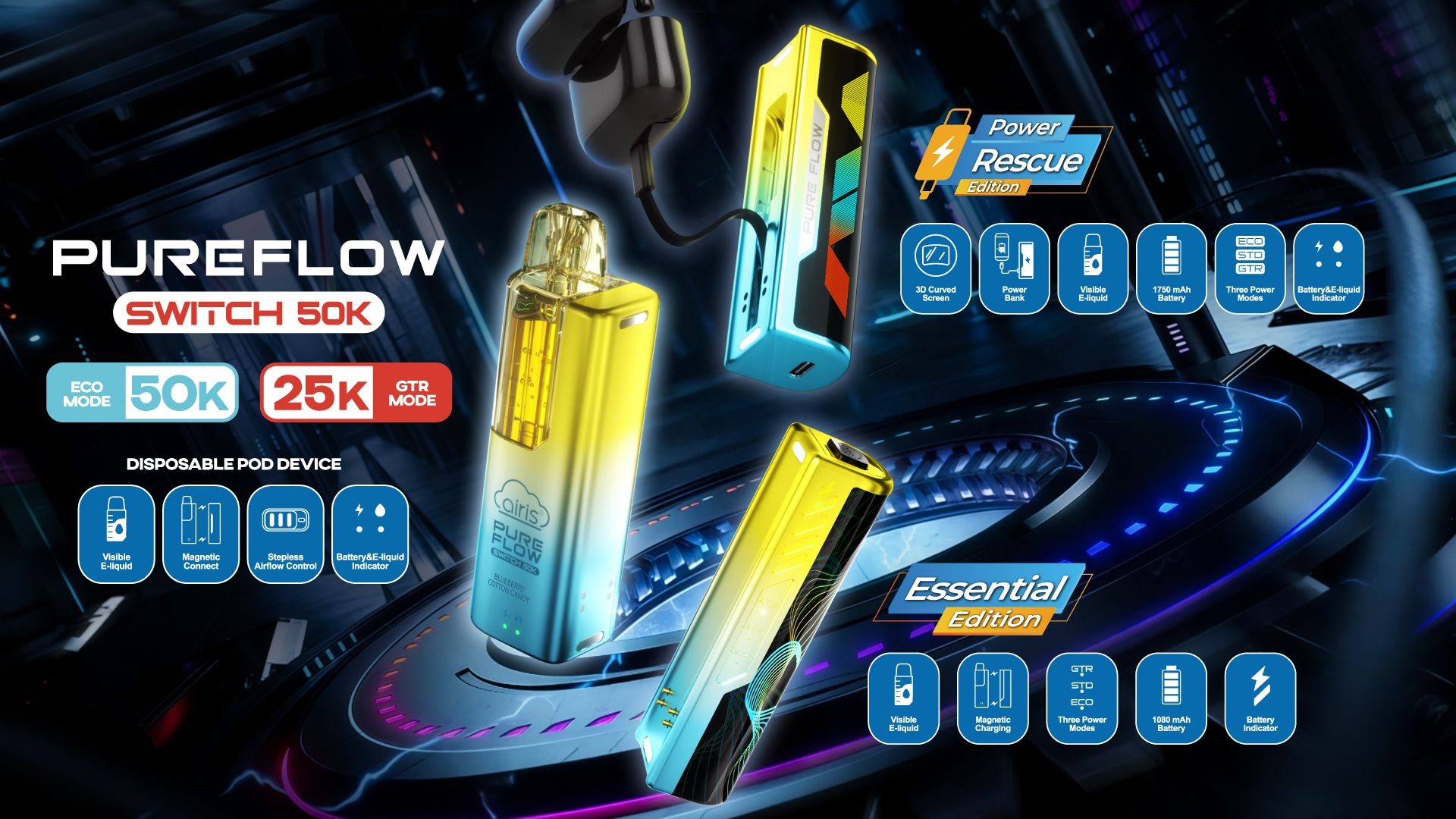
👉Click to view Airis-PureFlow Switch
Bringing It All Together
The surge in 30,000–50,000-puff disposables isn’t just a marketing stunt. It’s the market’s answer to five very real user pain points:
- Constantly replacing small devices
- Travel anxiety around battery life and puff count
- Flavor and power drop off halfway through the tank
- Confusing, volatile total cost over weeks and months
- Discomfort with the volume of hardware being thrown away
High-puff devices don’t magically solve everything, and they’re not the right answer for every vaper. But for heavy daily users and frequent travellers who care about stability, cost per day, and fewer headaches, the shift toward 30K–50K-class disposables is easy to understand.
If you want to go one step deeper into the technical side of high-puff design, check our guide What Is a High-Puff Disposable Vape?
When you’re ready to compare actual devices and see how different brands tackle these pain points, jump into our best 50,000-puff disposable vapes 2025 ranking — it’s where all of these ideas turn into specific products, scores, and real-world buying advice.
HIGH-PUFF · 30K–50K PAIN POINTS
These pain points sound familiar?
Our High-Puff Disposable Vapes 2025–2026 Guide pulls everything together – what high-puff really means, why 30K–50K devices solve these issues, how we test endurance, and which 50K vapes we actually recommend.