WARNING:This product contains nicotine.Nicotine is an addictive chemical.

The disposable vape market has changed fast. We’ve gone from 600-puff sticks to 30K–50K “high-puff” devices, from simple one-mode bars to products with screens, power modes, and even power-bank functions.
As we move toward 2026, the industry is clearly shifting from a “bigger number on the box” arms race to a more mature stage: more realistic puff labels, smarter power management, long-cycle flavor stability, and product forms that sit between full disposables and pod kits.
If you want a refresher on how high-puff products evolved, start with:
This article looks ahead: what 2026 is likely to look like, and what it means for everyday vapers.
If you’re mainly interested in 30K–50K puff devices themselves, our High-Puff Disposable Vapes 2025–2026 Guide gives a complete overview of what high-puff means, how we test endurance and which 50K vapes stand out.
Trend 1: Puff Labels Become More Rational
Regulatory Pressure and Market Education
In the early high-puff wave, some brands treated puff counts as pure marketing. Real-world performance often fell far short of what was printed on the box.
By 2026, three forces are pushing puff labels toward reality:
- Regulators in key markets are starting to look at total nicotine delivery and e-liquid volumes, not just bottle size. Wildly inflated puff numbers are a red flag.
- Retailers and wholesalers have learned the hard way that disappointed customers don’t come back. Shops are pushing suppliers for realistic numbers and test data.
- Consumers are more educated. Many now understand that coil design, power mode and usage pattern matter, and they actively call out devices that feel like “fake 50K”.
More Transparent Lab and Field Data
To stand out, more brands will publish at least basic test information:
- Lab-style puff-machine results
- Real-world testing ranges (for example, “20K–24K puffs in Eco mode for moderate users”)
- Clear notes on which mode the label refers to
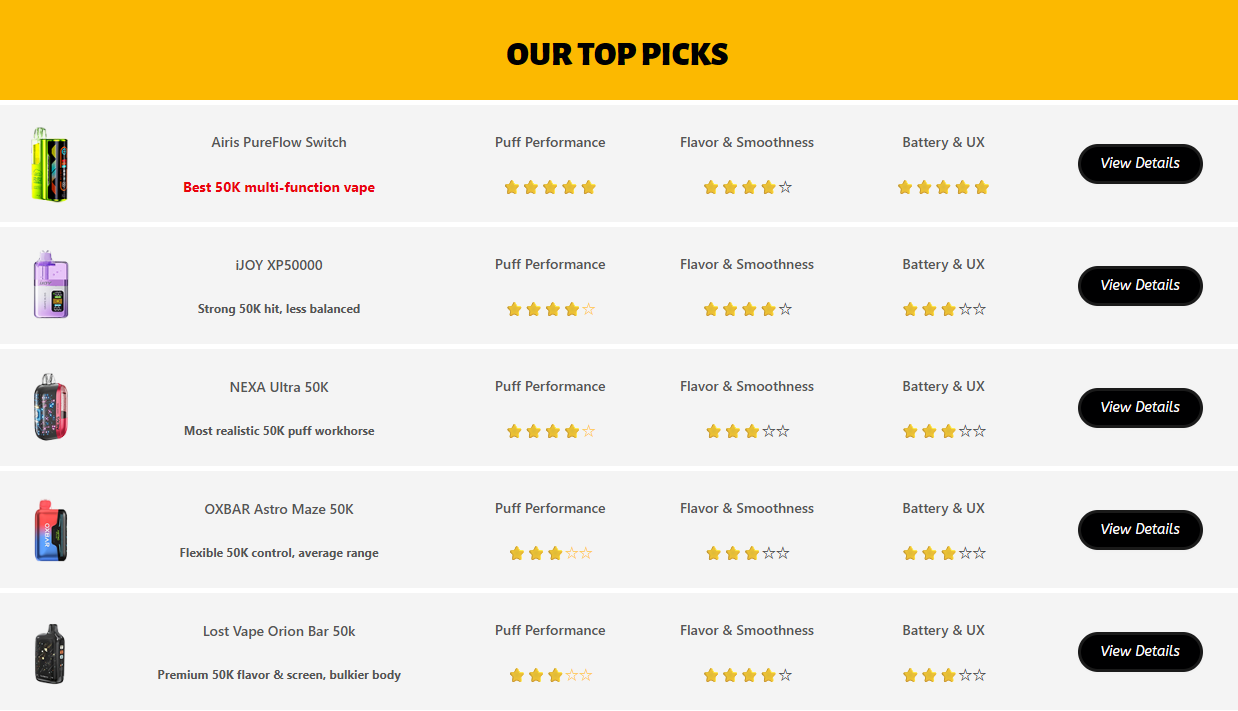
Review sites and buyers already reward brands that are honest and consistent. In 2026, this transparency becomes a competitive advantage, especially in the high-puff segment covered in our Best 50,000-Puff Disposable Vapes 2025 ranking.
Trend 2: Smarter Power Management for “Big Clouds + Long Endurance”
Multi-Level Power and Intelligent Curves
Early disposables were “one-speed”: you got whatever the fixed voltage and coil delivered. Modern high-puff devices already offer Eco / Normal / Boost modes. In 2026, expect this to become more refined:
- Multi-step power curves that start strong, then taper slightly to protect the coil and extend life
- Mode presets tuned for different profiles – for example, “flavor mode” for rich, dense vapor vs “endurance mode” for all-day use
- Adaptive output that monitors battery voltage and coil temperature to keep hits consistent, not just as strong as possible
The goal is simple: instead of forcing users to choose between “weak but long-lasting” and “strong but short-lived”, devices will increasingly target the sweet spot between clouds, flavor, and battery life.
Power Strategies for Heavy Users
Heavy vapers are the main buyers of 30K–50K devices. In 2026, we expect more products explicitly designed around their habits:
- Power modes that assume 800–1,000 puffs per day, not 200
- Thermal protection tuned to long chain-vaping sessions
- Smarter low-battery behavior – maintaining a consistent vape until the last 10–15% instead of slowly fading for days
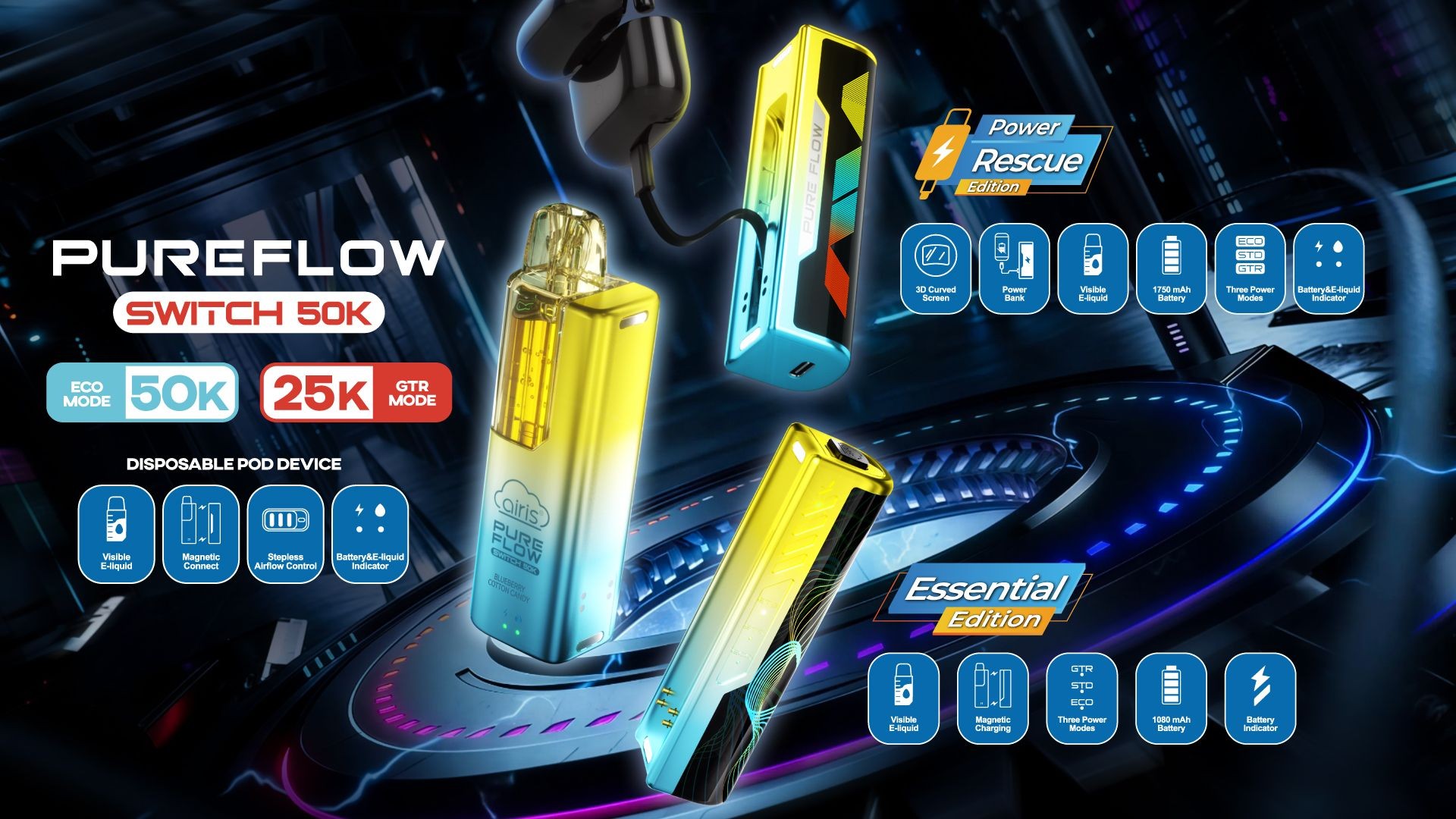
Our own high-puff flagship, introduced in the Airis PureFlow Switch launch, is an early example of this direction: a 50K-class device with power modes aimed at heavy daily use, not just occasional puffs. Expect more brands to follow.
Trend 3: Coils and E-Liquid Systems Optimized for Long Cycles
More Durable Coil Structures
Running the same coil for 30K–50K puffs is very different from running it for 2K. In 2026, we expect to see:
- Reinforced mesh and wicking materials designed to resist carbon buildup and dry spots over tens of thousands of puffs
- Coil geometries that prioritize even heat distribution to avoid hot spots that burn the wick early
- Better thermal management inside the pod or tank shell to keep long chain-vaping sessions stable
Devices that can maintain clean flavor for most of their advertised life will clearly stand out in endurance tests and user reviews.
E-Liquid Formulas for 30K–50K Life Cycles
E-liquid designed for 2K bars doesn’t necessarily work well for 50K devices:
- Heavy sweeteners and dark flavor concentrates can gunk up coils quickly
- Very sharp or icy profiles can cause flavor fatigue long before the tank is empty
For high-puff products, more brands will:
- Use cleaner, coil-friendly sweeteners
- Develop balanced, less cloying base profiles meant to be vaped for weeks
- Offer flavor families (for example, different fruit-menthols or dessert variants) that let users rotate without leaving the ecosystem
The aim is that you don’t dread the last third of a 50K bar because the flavor has collapsed or become sickly sweet.
Trend 4: Product Forms Move Toward “Semi-Disposable / Modular”
Replaceable Battery Modules and Refillable Structures
Pure disposables have convenience on their side, but they’re not perfect for cost or the environment. In 2026, we expect more products occupying the middle ground between disposables and full pod kits:
- Semi-disposable systems, where the battery is reusable but the pre-filled pod or tank is replaced
- Replaceable battery modules that slot into a pre-filled high-puff body, effectively separating power from e-liquid
- Top-up or limited-refill options designed around a small number of cycles (for example, two–three refills per coil) before replacement
These concepts try to keep the plug-and-play feel of disposables while cutting down on the number of fully discarded devices per month.
Balancing Compliance, Environment and Cost
Any semi-disposable structure has to stay within local laws on:
- Tank size and total e-liquid volume
- Nicotine strength and total nicotine per device
- Child-resistance and tamper-proofing
We’re likely to see region-specific versions of the same platform: fully disposable where rules demand it, more modular where regulations and distribution allow.
Trend 5: Bigger Screens, Bluetooth and “Smart” Features
As high-puff devices move upmarket, more brands are trying to stand out with large color displays, Bluetooth connectivity, animated UIs, even mini-games. On paper, these features make disposables feel more like gadgets than simple nicotine delivery tools.
What Smart Features Actually Add
Done well, smart functions can provide real value:
- Larger status displays – clearer battery, puff count, mode and coil warnings
- On-device settings – easier switching between Eco / Normal / Boost, NIC or ICE levels
- App connectivity – firmware updates, usage statistics, anti-loss alerts
For tech-savvy users who enjoy tweaking and monitoring their devices, this extra feedback can be genuinely useful.
Hidden Trade-Offs: Cost, Battery and Reliability
However, every added feature comes with a cost:
- Higher BOM and retail price – screens, chips and Bluetooth modules aren’t free
- Shorter practical endurance – displays and animations draw power that could have been used for actual puffs
- More potential failure points – complex firmware and extra hardware can mean more bugs, freezes or glitches
In other words, part of what you pay for in a “smart” disposable is electronics that don’t improve nicotine delivery or flavor, and in some cases may even compromise battery life.
Do Most Vapers Really Need Full Smart Devices?
For many everyday vapers and heavy users, the core priorities haven’t changed:
- honest puff counts
- stable flavor and vapor
- solid battery endurance
- reasonable cost over time
Big touchscreens and mini-games are nice to look at, but they can also feel like unnecessary complexity if they don’t make the vape itself better. We explore this question in more depth in Are Touchscreen Vapes Actually Useful or Just a Gimmick?, where we compare the real benefits with the extra cost and trade-offs.
Looking toward 2026, the likely outcome is that some flagships will keep pushing “smart” features, while a growing number of high-puff devices will deliberately stay simpler and focus on endurance, flavor and honest performance instead of gadget-style extras.
Trend 6: High-Puff Products vs Regulatory Environments
Different Limits in Different Regions
No global rulebook exists for high-puff vapes. Instead, brands have to navigate a patchwork of limits on:
- Maximum nicotine strength
- Maximum tank or pod volume
- Total nicotine or e-liquid per device
- Packaging and labeling requirements
In some markets, 50K-class products may face tighter scrutiny or indirect caps (for example, by limiting e-liquid volume so extreme puff counts are impractical). In others, they may remain widely available but under much closer surveillance.
Planning Products Inside the Compliance Box
Serious brands are already adjusting their roadmaps:
- Designing platforms that can scale up or down – the same chassis can support 10K, 20K, 30K or 50K variants depending on the market
- Building in firmware or hardware caps to comply with local wattage or puff-limit rules
- Focusing on long-term stability and truthful labeling, knowing that regulators are increasingly able to test devices themselves
In 2026, the winners will be brands that can convince both regulators and consumers that high-puff does not mean “out of control” – it means engineered, predictable and safe.
What Do These Trends Mean for Everyday Consumers?
Should You Jump Straight to 50K Now?
If you’re a light or moderate vaper, the honest answer is: not necessarily. For many people, a well-designed 10K–20K device hits a good balance of size, cost and flavor variety.
If you’re a heavy user or frequent traveler, our data and user feedback suggest that 30K–50K devices already solve real pain points around:
- constantly replacing small bars
- running out during trips
- unpredictable monthly cost
To see how today’s options stack up before you buy, check our updated Best 50,000-Puff Disposable Vapes 2025 list – it will keep evolving as 2026 launches arrive.
Better Options Coming in the Next 1–2 Years
The broader trend is positive for consumers:
- Puff labels are becoming more honest
- Coil and e-liquid systems are being optimized for longer, cleaner life cycles
- Semi-disposable and modular designs will open up more cost-effective and eco-conscious choices
- “Smart” features will gradually settle into two camps – serious tools (clear status, simple controls) and superficial gimmicks you can avoid if you don’t care
If you’re happy with your current setup, there’s no need to panic-buy. But if your 2K–5K bars constantly leave you frustrated, 2026 is a good time to consider a high-puff upgrade.
Brand Perspective: Where We’ll Focus Around 2026
Without turning this into a product brochure, here are the principles guiding our own roadmap.
More Honest Puff Labels
We’re committed to making puff counts match realistic scenarios, not just lab maximums, and to explaining clearly how numbers are measured. That’s the logic behind the testing and scoring approach in our high-puff reviews and rankings.
Smarter Power and Endurance Balance
Future platforms will put more work into intelligent power modes and coil-friendly e-liquid recipes so heavy users can enjoy strong, satisfying hits without sacrificing coil life or battery stability. Devices like the Airis PureFlow Switch – a multi-function 50K-class device – are early steps in that direction.
Clearer Product Lines: Medium Endurance vs High-Puff Flagships
We’ll continue to separate:
- Medium-puff products for everyday users who care about pocketability and flavor rotation
- High-puff flagships for heavy users and travelers who value long-range endurance and multi-mode flexibility
As 2026 unfolds, expect the entire vape industry to move in a similar direction: less noise around extreme numbers, more focus on reliable endurance, clear positioning and honest performance. For consumers, that’s a trend worth welcoming.
HIGH-PUFF · 30K–50K PUFFS
If these 2026 trends have you thinking about moving up to a 30K–50K device, start with our High-Puff Disposable Vapes 2025–2026 Guide.
It brings together the basics, real user pain points, endurance testing, top 50K picks and long-term outlook in one place.