WARNING:This product contains nicotine.Nicotine is an addictive chemical.

When a device claims 30,000 or even 50,000 puffs, most vapers have the same reaction:
“Is that a real number, or just something printed on the box?”
To make our rankings and reviews credible, we need a clear, repeatable way to test endurance and stability on high-puff devices. This article explains the test logic we follow: how we simulate real use, what we measure, and how the final scores are calculated.

Suppose you’re new to the “high-puff” concept itself. In that case, it’s worth reading our explainer on what a high-puff disposable actually is and our analysis of why 30K–50K puff vapes are becoming the new trend before diving into methodology.
Why High-Puff Devices Need Their Own Test System
These endurance methods are part of our broader 30K–50K framework. If you want the full picture – from what high-puff means to real user pain points, rankings and 2026 trends – check our High-Puff Disposable Vapes 2025–2026 Guide.
Longer Life = More Time for Problems to Show
A 2,000-puff bar usually dies in a few days for a heavy user. If there’s a minor inconsistency, you may not even notice before the device is finished.
A 30K–50K device lives with you for weeks:
- Coils go through many more heat cycles
- E-liquid stays in the tank for a much longer time
- Small design flaws have more time to turn into real issues
That’s why we care not only about “day one performance”, but also about “week three performance”.
We Have to Test Long-Term Stability, Not Just First Impressions
A high-puff disposable that feels amazing during the first 5,000 puffs but drops off sharply afterwards is not a good endurance device.
So our framework pays special attention to:
- How stable flavor, vapor, and throat hit over the entire life cycle
- Whether power delivery remains consistent, not just in the first days
- Whether leaks, gurgling,g, or burnt hits start to appear late in the tank
In other words, we test whether a high-puff device can maintain itself over time, not just win a first-impression contest.
Lab-Style Testing: Puff Count and Performance Under Standard Conditions
The first pillar of our system is controlled, repeatable testing under fixed conditions. We’re not trying to mimic every real-world scenario here – just to answer one question:
“Under a standardized draw, how close is the real puff count and performance to what the brand claims?”
Standardized Draw: Resistance, Puff Length, and Interval
To do that, we keep these variables as constant as possible:
- Draw resistance – we measure puffing under a consistent airflow, comparable to a loose MTL draw.
- Puff duration – each puff is kept around the same length (for example, ~3 seconds), so a “puff” always means the same thing.
- Interval between puffs – puffs are spaced at fixed intervals (e.g, 20–30 seconds) to avoid overheating the coil or artificially boosting puff count.
By controlling these three factors, we can compare different devices on a fair basis.
Fixed Power, Nicotine Strength and Liquid Recipe
Where possible, we also:
- Use devices with comparable nicotine strength (typically 5%)
- Test in the same power mode (Normal/Eco) instead of Boost modes
- Use stock devices with the factory e-liquid formula, not custom juices
This keeps our puff-count comparison focused on hardware and coil efficiency rather than on different recipes or aggressive Boost modes.
Recording Claimed vs Measured Puff Count
For every sample, we log:
- Manufacturer’s claimed puff count
- Our measured puff count under standard conditions
- Whether performance drops sharply before the device is technically “empty.”
Instead of just asking “did it hit 50,000”, we also look at how many puffs stayed in the “good experience” zone before flavor or power collapsed.
These numbers directly feed into our high-puff ranking and the device-specific reviews you’ll see in our best 50,000-puff disposable vapes 2025 ranking.
Real-World Scenario Testing: Simulating Different Types of Users
Lab conditions are useful, but real people don’t vape in perfect 3-second intervals all day. The second pillar of our system is scenario testing, where we approximate how different users actually vape.
Light Users: 200–400 Puffs per Day
- Typically, ex-smokers who only vape at specific times
- A 10K device can last them weeks
In this scenario, we watch for:
- Whether flavor goes stale when the same liquid sits in the tank for a long time
- Whether the battery shows any self-discharge issues
Moderate Users: 600–800 Puffs per Day
- People who vape throughout the day, but not heavily chain-vaping
- A 30K bar may last a month or more
Here we pay attention to:
- How stable does the device feel in week two and week three
- Whether the user needs to recharge more often than the spec suggests
Heavy Users: 1,000+ Puffs per Day / Long Chain Sessions
- Former pack-a-day smokers or stressed professionals
- 2K devices disappear in days, which is exactly the group that drives demand for high-puff devices
For this segment, we test:
- How the device handles long chain-vaping sessions
- Whether the body gets too hot
- Whether dry hits or burnt flavor appear under sustained use
Across all three scenarios, we compare notes: does the device behave consistently in different hands, or does performance collapse under heavy use?
Core Dimensions We Use to Evaluate High-Puff Devices
To turn observations into scores, we break high-puff performance into several key dimensions.
Puff Count Authenticity
- How close is the realistic puff count to the marketing claim?
- Does the device stay enjoyable for most of those puffs, or only on paper?
We’re not hunting for “perfect” alignment, but we do penalize devices that feel dramatically shorter than promised.
Flavor Stability Over the Tank Life
We divide usage into three stages:
- First third – “new device” impressions
- Middle third – daily workhorse phase
- Final third – end-of-life performance
We track whether flavor stays:
- recognisable
- balanced
- free from burnt or overly muted notes
Devices that start strong but become nearly flavorless near the end will not score well, even if the puff counter looks good.
Vapor Volume and Throat Hit
High-puff devices are often used by heavier vapers who care about satisfaction per puff. We evaluate:
- How dense and consistent the vapor is
- How the throat hit feels in different modes (Eco vs Boost, if available)
- Whether the hit becomes too harsh or too weak over time
Battery Endurance and Charging Experience
Here we look at:
- How many puff cycles per charge do we actually get
- How long a full charge take in real conditions
- Whether the device can be used while charging (if advertised)
- Whether the charge port and cable feel solid or fragile
A device with strong puff performance but constant charging headaches will lose points.
Reliability: Leaks, Dry Hits and Failures
We log any:
- Leaking or seepage around the mouthpiece or airflow
- Gurgling, spitback or dry hits
- Device failures (auto-fire, not firing, stuck indicators, etc.)
Even if these issues are rare, they weigh heavily in the final reliability score.
Build Quality and Ergonomics
Finally, we evaluate:
- Perceived build quality and assembly
- Weight and size relative to puff class
- Pocket comfort and grip
- Button and slider feel (if present)
High-puff devices can get big and heavy. We reward designs that deliver serious endurance without becoming bricks.
Scoring System: Weighting and Overall Rating
To make results comparable across devices, we assign weights to each dimension. A typical breakdown looks like this:
- 30% – Puff count authenticity & stability
- 25% – Flavor & vapor performance
- 20% – Battery & charging experience
- 15% – Reliability & failure rate
- 10% – Design, ergonomics & overall feel
Each sub-dimension gets a score (for example, 1–10). We then:
- Multiply each sub-score by its weight
- Add them up to get a total score on a 100-point scale
- Convert that to a star or tier rating in the final article
This way, no single “cool spec” can hide serious weaknesses in other areas.
How Test Results Shape Rankings and Review Articles
What Counts as “Top Tier” vs “Recommended with Trade-Offs”
In our internal language:
- Top Tier devices:
- Score above 85/100
- Show honest puff counts, stable flavor, solid reliability
- Have no critical red flags, only minor preferences (size, styling, etc.)
- Recommended, but with trade-offs:
- Score 70–85/100
- Perform well overall but have one or two outstanding weaknesses
- They are clearly right for certain users, clearly wrong for others
When you read our best 50,000-puff disposable vapes 2025 ranking, that’s the logic behind the scores, tiers and “who it’s for” notes.
Why Some Spec Monsters Don’t Rank as High as You’d Expect
You’ll sometimes see a device with amazing on-paper specs – huge battery, massive tank, multiple modes – that doesn’t land in the top spot.
Common reasons include:
- Puff count looks great, but real-world experience drops off after the middle third
- High power modes taste good, but kill the coil too early
- Size and weight cross the line where users stop carrying the device every day
- Reliability issues (leaks, misfires) drag down the overall score
Conversely, a more balanced device with slightly lower headline numbers can climb higher because it scores well across all weighted dimensions.
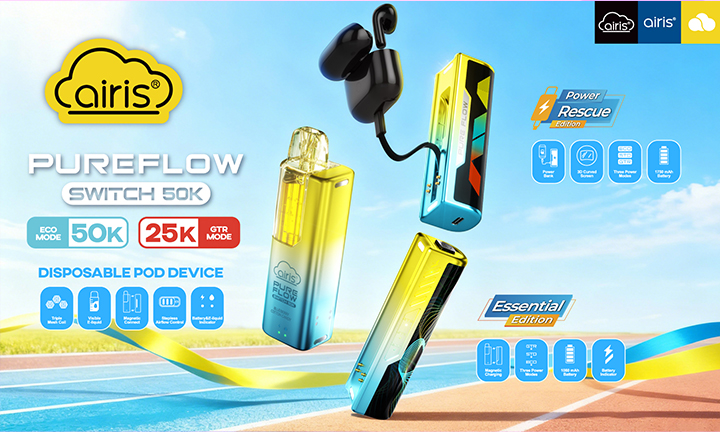
A good example of how this balance plays out in practice is our own modular, high-puff platform covered in the Airis PureFlow Switch. The goal isn’t just to chase a big puff number; it’s to perform well under the kind of test logic you’ve just read.
Why This Testing Framework Matters
For heavy vapers, shop owners and distributors, “50K” on a box is no longer enough. What matters is:
- How honest is that number achieved
- How the device behaves throughout its life
- How reliable and comfortable it is to live with every day
By combining lab-style testing with real-world user simulations, and by scoring devices across clearly weighted dimensions, we aim to provide rankings and reviews that are transparent, reproducible and actually useful.
If you’d like to see how this framework plays out device by device, start with our high-puff explainer and trend analysis:
Then check the latest results in our Best 50,000-Puff Disposable Vapes 2025 ranking to see which devices actually pass this test – and why.
HIGH-PUFF · TESTING & 30K–50K PUFFS
Want to see how these endurance tests shape real 30K–50K recommendations?
Our High-Puff Disposable Vapes 2025–2026 Guide brings this testing framework together with user pain points, 50K rankings and buying advice for heavy and travel vapers in one place.